Benefits to a School Wide Vermicomposting Program
- Take responsibility for school's waste
- Recycle natural resources
- Educate the community about the benefits of composting
- Change cultural attitudes about garbage in a way that will benefit society
- Affect the life style decisions made by future citizens of the community
- Reduce the school solid waste stream
- Enhance teaching of science concepts
- Teach social responsibility
- Empower students (gives them a specific action they can take to help the earth)
- Inform parents as well as students about composting
- Provide a soil amendment for school gardening projects or for sale as a fund raiser
- Help the school work toward becoming a "green school"
- Foster a sense of school pride
|
|
|
|
Grade 6th Science
Academic Content Standards Connections 
Life Sciences
Explain how energy entering the ecosystems as sunlight supports the life of organisms through photosynthesis and the transfer of energy through the interactions of organisms and the environment.
Physical Sciences
Relate uses, properties and chemical processes to the behavior and/or arrangement of the small particles that compose matter.
Describe renewable and nonrenewable sources of energy (e.g., solar, wind, fossil fuels, biomass, hydroelectricity, geothermal and nuclear energy) and the management of these sources
Science and Technology
Give examples of how technological advances, influenced by scientific knowledge, affect the quality of life.
Design a solution or product taking into account needs and constraints (e.g., cost, time, trade-offs, properties of materials, safety and aesthetics).
Scientific Inquiry
Explain that there are differing sets of procedures for guiding scientific investigations and procedures are determined by the nature of the investigation, safety considerations and appropriate tools.
Analyze and interpret data from scientific investigations using appropriate mathematical skills in order to draw valid conclusions.
Scientific Ways of Knowing
Use skills of scientific inquiry processes (e.g., hypothesis, record keeping, description and explanation).
Give examples of how thinking scientifically is helpful in daily life.
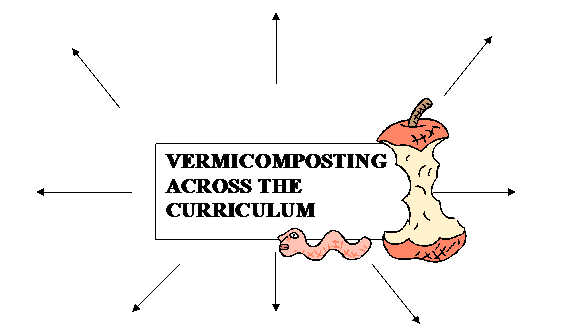
Language Arts
Read biographies about environmental leaders and conduct a book bistro.
Write Worm Poems
Social Studies
Research the history of dumps and landfills. Create a time line of events that lead to current methods of solid waste disposal.
Math
Analyze the pattern of waste disposal at school.
Music & Art
Decorate compost bins.
Compose and perform jingles to encourage waste reduction
participation.
Create posters for the cafeteria to detail waste sorting.
Sketch changes observed in compost or sketch compost critters.
Health and Physical Education
Research waste management techniques and debate the advantages and disadvantages of each as they affect human health.
Research how consumer choices affect the environment.
Science
Investigate the variables that affect compost efficiency.
Analyze soil types and soil profiles.
Describe the interdependency of plant, mineral, and animal kingdoms to the earthworm.
Apply the Scientific Method to compost management.
Languages
Compare solid waste management techniques in given countries to those practiced in the United States.
Computer
Design flyers for community wide compost sales.
Create spread sheets and graphs to display compost data as it changes.
 Composting Bookshelf Composting Bookshelf
Teachers Resources:
Mid-Scale Vermicomposting of Lunchroom Wastes
by Binet Payne
Flower Press 1999
ISBN 0-942256-11-5
Worms Eat Our Garbage by Mary Appelhof, Mary Frances Fenton, and Barbara Loss Harris
Flower Press 1993
ISBN 0-942256-05-0
Life In A Bucket Of Soil by Alvin and Virginia Silverstein
Dover Publications 2000
ISBN-13: 978-0486410579
Project Food, Land & People Resources for Learning
copyright 1998
Project Food, Land & People
1990 N. Alma School Road, #36
Chandler, AZ 85224
(602) 963-7959
Smart Consumers: An Educator’s Guide to Exploring Consumer Issues and the Environment
# EE-12501 $29.95 Available from Acorn Naturalists
1-800-422-886
Other Teacher Resources:
Compost Gin (Card Game) Rot and Roll (CD)
#G-8029 $12.95 #CD-13442 $14.95
Compost Poster
#PO-1447 $5.95
All Available through Acorn Naturalists
(1-800-422-8886)
Student Resources:
Soil by Adele D. Richardson ISBN 0-7368-0954-6
Bridgestone Books 2002
Earthworms by Elaine Pascoe ISBN 1-56711-177-7
Blackbirch Press, Inc. 1997
Compost Critters by Bianca Lavies ISBN 0-525-44763-6
Dutton Children’s Books 1993
There’s A Hair In My Dirt by Gary Larson, Harper Collins Publisher 1998
Composting: An Easy Household Guide by Nicky Scott
Chelsea Green Publishing, 2007 ISBN-10: 1933392746
Earth Heroes: Champions of the Wilderness by Carol & Bruce Malnor
Dawn Pubns, 2009
ISBN-10 1584691167
John Muir, My Life With Nature by Joseph Cornell
Dawn Pubns, 2000
ISBN-10: 1584690097
Walking with Henry, based on the Life and Works of Henry David Thoreau ( and teacher’s guide) by Thomas Locker
Fulcrum Publishing, 2002
ISBN-10: 1555913555
Eco-Women, Protectors of Earth by Willow Ann Sirch
Fulcrum Publishing, 2009
ISBN-10: 1555912524
Girls Who Looked Under Rocks, The Lives of Six Pioneering Naturalists by Jeannine Atkins and Paula Conner
Dawn Publication, 2000
ISBN-10: 1584690119
Silent Spring by Rachel Carson
Mariner Books, Anv edition, 2002
ISBN-10: 0618249060
The Earth is My Mother by Bev Doolittle and Elise Maclay
The Greenwich Workshop Press, 2000
ISBN-10: 0867130447
Resources for students with special needs
Lifetimes (and Curriculum) by David L. Rice
Dawn Publications, 1997
ISBN-10: 1883220599
In A Nutshell by Joseph Anthony Arbo
Dawn Publications, 1999
ISBN-10: 188322098x
Terrarium Habitats by Kimi Hosoume & Jacqueline Barber
Great Explorations, 2000
ISBN-10: 092488651x
A Log’s Life by Wendy Pfeffer & Robin Brickman
Aladdin, 2007
ISBN-10: 1416934839
Helpful Compost Websites
1. http://portage.osu.edu/
2. www.howtocompost.org
3. www.wormwoman.com
4. http://compostingcouncil.org
5. www.cfe.cornelledu/compost/
6. www.cityfarmer.org/wormcomp61.html
7. www.epa.gov
8. http://sustainable.tamu.edu/slidesets/kidscompost/kid1.html
9. http://www.nrcs.usda.gov/FEATURE/backyard/compost.html
|